

Blackjack stands as one of the most popular casino games worldwide, where players try to beat the dealer by getting as close to 21 points as possible without going over. Unlike many other casino games that rely purely on luck, blackjack offers players the chance to use strategy and skill to improve their odds of winning.
The goal is simple: get a hand value closer to 21 than the dealer without exceeding 21, which is called “busting.” Cards 2-10 are worth their face value, face cards are worth 10 points, and aces can be worth either 1 or 11 points depending on what helps the hand most.
Understanding the basic rules, table layout, and proper strategy can significantly improve a player’s chances at the blackjack table. This guide covers everything from the fundamental gameplay mechanics to advanced strategies, helping both beginners learn the basics and experienced players refine their approach to this classic card game.
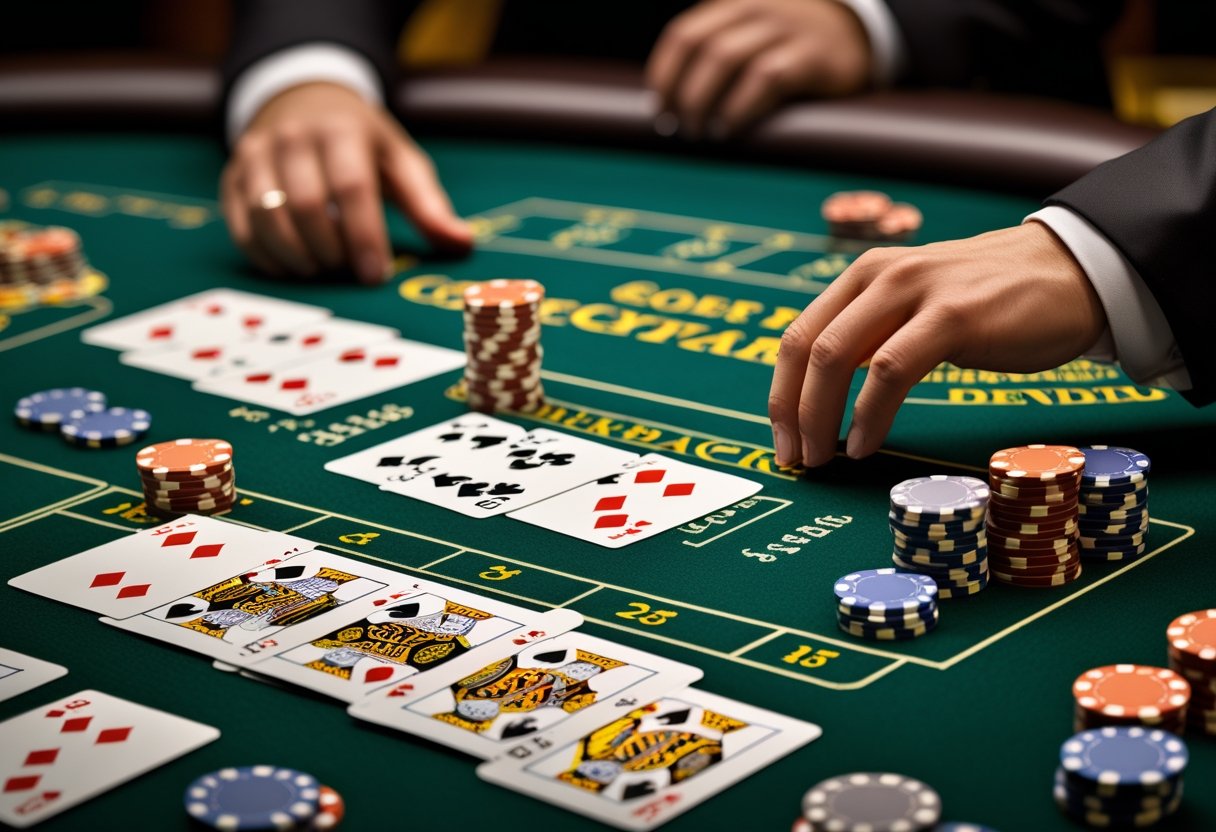
Understanding Blackjack Rules
Blackjack rules center on getting cards that total 21 or as close as possible without going over while beating the dealer’s hand. The game uses standard card values where face cards equal 10 and aces count as 1 or 11.
Objective of Blackjack
The goal in blackjack is to beat the dealer’s hand without exceeding 21 points. Players win by having a hand total closer to 21 than the dealer’s hand.
A player loses immediately if their hand goes over 21, which is called a “bust.” This happens even if the dealer later busts too.
Blackjack is the best possible hand. It consists of an ace and any 10-value card (10, jack, queen, or king) dealt in the first two cards.
Players do not compete against each other. Each player only plays against the dealer’s hand.
The dealer must follow strict rules about when to take additional cards. Players have more choices about their actions during the game.
Basic Game Play
Each player receives two cards face up at the start. The dealer gets two cards with one face up and one face down.
Players look at their cards and decide their next move. They can take another card, keep their current total, or use other available options.
Hit means taking another card. Stand means keeping the current hand total without taking more cards.
Players make decisions in order around the table. After all players finish, the dealer reveals the hidden card and plays their hand.
The dealer must hit if their total is 16 or less. The dealer must stand if their total is 17 or more.
Winners receive payouts based on their bet amount. Standard wins pay 1:1, while blackjack typically pays 3:2.
Card Values and Scoring
Number cards (2-10) are worth their face value. All face cards (jack, queen, king) count as 10 points each.
Aces are special cards that can count as either 1 or 11. Players use whichever value helps their hand the most.
| Card Type | Value |
|---|---|
| 2-10 | Face value |
| Jack, Queen, King | 10 |
| Ace | 1 or 11 |
A soft hand contains an ace counted as 11. A hard hand has no ace or counts the ace as 1.
For example, ace-6 is a soft 17. If the player hits and gets a 9, the ace becomes 1 for a hard 16.
Hand totals over 21 result in an automatic loss called a bust. This is the most important rule to remember.
Common Variations
Double Down lets players double their bet and receive exactly one more card. This option is available on the first two cards only.
Split is available when a player’s first two cards have the same value. The player creates two separate hands with equal bets.
Some games allow surrender, where players give up half their bet to fold a poor hand. This option saves money on very weak hands.
Insurance is offered when the dealer’s face-up card is an ace. Players can bet up to half their original wager that the dealer has blackjack.
Different casinos may have varying rules about doubling after splits, the number of times players can split, or dealer actions on soft 17.

Blackjack Table Layout
The blackjack table follows a specific design with marked areas for betting, card play, and dealer operations. Players sit around a semicircular table with designated spots, while the dealer manages the game from their position across from the players.
Table Features
The blackjack table has a semicircular shape covered in green felt. This design allows up to seven players to sit around the curved edge.
Each player position has a betting circle or square marked on the felt. Players must place their chips inside this area before cards are dealt.
The table displays important game rules printed on the felt. These include:
- Blackjack pays 3 to 2 (or sometimes 6 to 5)
- Dealer must hit on 16 and stand on 17
- Insurance pays 2 to 1
A shoe sits on the dealer’s left side. This plastic or wooden device holds multiple decks of cards for dealing.
The table also features a discard tray where used cards go after each hand. Some tables have side bet areas for optional wagers like Perfect Pairs or 21+3.
Seating Positions
Blackjack tables typically have seven numbered seats. Position 1 sits at the dealer’s far left, while position 7 is at the far right.
First base refers to the seat closest to the shoe (usually position 1). This player receives cards first and acts first on their hand.
Third base is the seat farthest from the shoe (position 7). This player acts last before the dealer plays their hand.
Players can sit at any open seat. The position does not affect the odds or game outcome.
Some players prefer third base because they see all other players’ decisions first. Others like first base to avoid pressure from other players.
Dealer Area
The dealer stands behind a straight edge of the table opposite the players. This area contains several important components for game management.
The chip rack sits directly in front of the dealer. It holds chips in different denominations organized by color and value.
A money slot in the table surface allows dealers to deposit cash from buy-ins. Paper money goes into a secure box below the table.
The dealer has a hand area marked on the felt where they place their cards. This spot is usually positioned in the center of their side.
Shoe position stays on the dealer’s left side for easy card access. Single-deck games may not use a shoe at all.
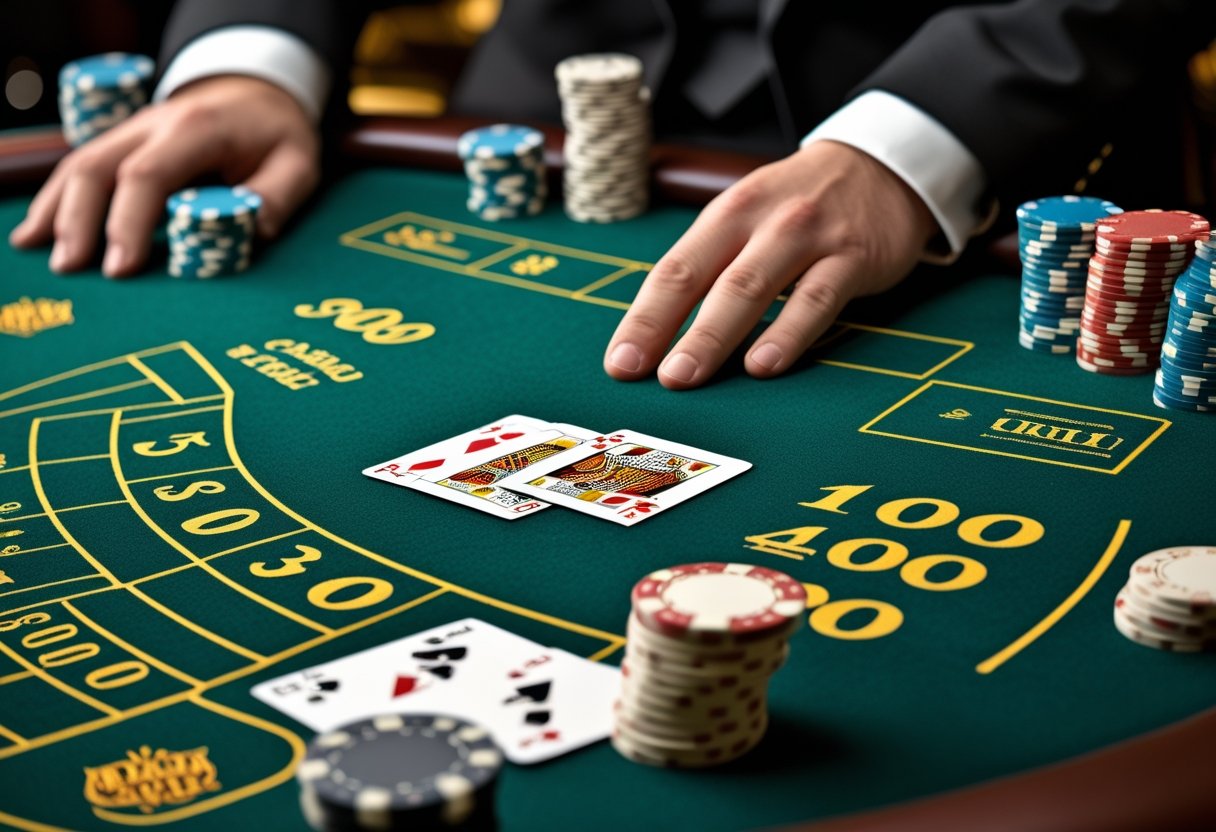
How to Play Blackjack
Blackjack follows a clear game flow where players compete against the dealer to reach 21 without going over. Players make decisions to hit, stand, double down, or split while the dealer follows fixed rules for drawing cards.
Step-by-Step Game Flow
Players start by placing their bets in the designated betting area. The dealer then deals two cards face up to each player and two cards to themselves – one face up and one face down.
Each player looks at their cards and adds up the total value. Number cards count as their face value, face cards equal 10, and aces count as either 1 or 11.
Players take turns making decisions starting from the dealer’s left. They can hit for more cards, stand to keep their total, or use other options like doubling down or splitting pairs.
After all players finish their hands, the dealer reveals their hidden card. The dealer must hit on totals of 16 or less and stand on 17 or higher.
Winners get paid based on their hand outcomes. Players with 21 beat lower totals, while hands over 21 automatically lose.
Player Actions
Hit means taking another card to increase the hand total. Players can hit multiple times until they reach 21 or go over.
Stand means keeping the current hand total without taking more cards. This ends the player’s turn for that hand.
Double Down allows players to double their bet and receive exactly one more card. This option is typically available on the first two cards only.
Split lets players separate matching cards into two hands when dealt a pair. Each hand gets a separate bet equal to the original wager.
Surrender permits players to give up half their bet and fold their hand. This option isn’t available at all tables.
Dealer’s Role
The dealer manages the game flow and follows strict rules for their own hand. They cannot make strategic decisions like players can.
Dealers must hit when their hand totals 16 or less. They must stand when reaching 17 or higher, including soft 17 (ace counted as 11) at most tables.
The dealer pays winning bets and collects losing wagers after all hands are complete. Blackjack (21 with first two cards) typically pays 3:2 odds.
If the dealer busts by going over 21, all remaining players win automatically. The dealer’s face-down card stays hidden until all players finish their actions.
Blackjack Odds Explained
Blackjack offers some of the best odds in the casino with a house edge as low as 0.5% when using basic strategy. The standard payout for blackjack is 3:2, while most other winning hands pay 1:1.
House Edge Overview
The house edge in blackjack represents the casino’s mathematical advantage over players. With perfect basic strategy, players face a house edge of approximately 0.5% to 1%.
This means the casino expects to win about 50 cents to $1 for every $100 wagered over time. However, poor playing decisions can increase the house edge to 2% or higher.
Several factors affect the house edge:
- Number of decks: Single deck games offer better odds than multi-deck games
- Dealer rules: Whether dealer hits or stands on soft 17
- Surrender options: Early or late surrender can reduce house edge
- Double down restrictions: Rules limiting when players can double
The house edge varies significantly between different blackjack variations. Games with favorable rules can reduce the edge to as low as 0.28%.
Payout Ratios
Standard blackjack payouts determine how much players win for different outcomes. The most important payout is for a natural blackjack, which traditionally pays 3:2.
Standard Payout Structure:
- Natural blackjack: 3:2 (bet $10, win $15)
- Regular win: 1:1 (bet $10, win $10)
- Insurance: 2:1 (bet $5, win $10)
- Push: Original bet returned
Many casinos now offer 6:5 blackjack games instead of 3:2. This change increases the house edge by approximately 1.4%.
Players should avoid 6:5 games whenever possible. A $10 bet on natural blackjack pays $12 in 6:5 games versus $15 in 3:2 games.
Some side bets offer higher payouts but come with much worse odds for players.
Probability of Common Outcomes
Understanding the probability of different outcomes helps players make better decisions. The dealer busts approximately 28% of the time across all possible scenarios.
Player Bust Probabilities by Hand Value:
- 12: 31%
- 13: 39%
- 14: 46%
- 15: 54%
- 16: 62%
The dealer’s upcard significantly affects bust probability. Dealers bust most often with a 5 showing (42%) and least often with a 10 or ace (21% and 17%).
Players win approximately 42% of hands, lose 49%, and push 9%. These percentages assume basic strategy play.
The probability of getting a natural blackjack is about 4.8% or roughly 1 in 21 hands. This occurs when players receive an ace and ten-value card in their first two cards.
Blackjack Strategy Charts
Strategy charts tell players exactly when to hit, stand, double down, or split based on their cards and the dealer’s up card. These charts use math to show the best move for every possible hand combination.
How to Read Strategy Charts
Blackjack strategy charts display player hands on the left side and dealer up cards across the top. Each box shows the best action using letters or colors.
H means hit. S means stand. D means double down. P means split.
Some charts use colors instead of letters. Green often means stand. Red means hit. Yellow shows double down or split moves.
Hard hands are hands without an ace or where the ace counts as 1. Soft hands contain an ace that counts as 11. Pairs get their own section on most charts.
Players find their hand total on the left. Then they look across to the column showing the dealer’s up card. The box where these meet shows the correct play.
Best Basic Strategy Moves
Basic strategy charts reduce the house edge to about 0.5% when followed perfectly. The most important rules apply to common situations players face.
Always split aces and 8s. Never split 5s or 10s. Split other pairs only when the chart says to do so.
Hit on hard totals of 11 or less. Always hit soft 17 or less. Stand on hard 17 through 21.
Double down on hard 10 or 11 when the dealer shows weak cards like 2 through 6. Double soft hands like A-2 through A-7 against dealer’s weak up cards.
Stand on hard 12 through 16 when the dealer shows 2 through 6. Hit these hands when the dealer shows 7 through ace.
Using Charts at the Table
Most casinos allow players to use strategy charts at blackjack tables. Players can bring printed cards or use their phones to check the correct play.
New players should study charts before playing. This helps them make faster decisions during the game. Quick play keeps the game moving smoothly.
Charts work best for standard blackjack rules. Different rules like surrender or dealer hits soft 17 require different charts. Players must match their chart to the specific game rules.
Practice using charts at home first. This builds confidence and speed. Online blackjack games let players practice with charts without pressure from other players.
Advanced Blackjack Strategies
Card counting can shift the odds in a player’s favor by tracking which cards remain in the deck. Side bets may seem appealing but typically carry much higher house edges than the main game.
Card Counting Basics
Card counting tracks the ratio of high cards to low cards remaining in the deck. When more high cards remain, players have better odds of getting blackjack or strong hands.
The Hi-Lo system is the most popular method. Players assign values to cards:
- Low cards (2-6): +1
- Neutral cards (7-9): 0
- High cards (10-Ace): -1
Players keep a running count by adding or subtracting as cards are dealt. A positive count means more high cards remain in the deck.
True count adjusts the running count for multiple decks. Players divide the running count by the estimated number of decks left. This gives a more accurate picture.
When the true count reaches +2 or higher, players should increase their bets. The higher the count, the better the player’s advantage becomes.
Card counting requires practice and concentration. Casinos watch for counters and may ban them from play.
Side Bets and Their Risks
Side bets offer additional ways to wager but come with steep house edges. Most side bets have house edges between 3% and 25%, much higher than basic blackjack’s 0.5%.
Insurance is the most common side bet. It pays 2:1 when the dealer has blackjack. The house edge on insurance is 7.4%, making it a poor choice for most players.
Perfect Pairs bets win when a player’s first two cards form a pair. Mixed pairs pay 6:1, colored pairs pay 12:1, and perfect pairs pay 25:1. The house edge ranges from 2% to 11%.
21+3 combines poker and blackjack. It wins when the player’s two cards plus the dealer’s up card make a poker hand. Flushes, straights, and three-of-a-kind trigger payouts.
Card counters may find value in some side bets when the count is very high. Regular players should avoid side bets due to their poor odds.
Etiquette at the Blackjack Table
Following proper etiquette keeps the game running smoothly and creates a better experience for everyone. Players must know how to behave at the table and handle their money correctly.
Behavioral Expectations
Players should sit down quietly and wait for the current hand to finish before joining. They must not touch other players’ cards or chips at any time.
Communication with the dealer should be clear and polite. Players use hand signals instead of words to make decisions. They wave their hand over cards to stand or tap the table to hit.
Players should never give advice to other players unless asked. Each person makes their own decisions about their hand. Criticizing someone’s play creates tension at the table.
Cell phone use should be limited. Players can take quick calls but should step away for long conversations. Taking photos of cards or the table is not allowed in most casinos.
Players must keep their drinks away from the playing area. Spilling liquid on cards can damage them and stop the game.
Handling Chips and Bets
Players place their bet in the betting circle before cards are dealt. They cannot touch their chips once the dealer starts dealing cards.
Chip stacking follows a simple rule. Players put larger value chips on the bottom and smaller ones on top. This helps the dealer see the bet amount quickly.
Players should not hand money directly to the dealer. They place cash on the table and wait for the dealer to exchange it for chips.
Tipping the dealer is common but not required. Players can tip by placing a small bet for the dealer or giving chips directly after winning a hand.
Players must keep their chips organized and visible at all times. Hiding chips or removing them from the table during play is against the rules.
Differences Between Online and Live Blackjack
Online blackjack uses computer software to deal cards instantly, while live blackjack features real dealers managing physical cards through video streaming. The main differences involve game speed, interaction levels, and betting requirements.
Game Experience Comparison
Online blackjack games move much faster than live dealer versions. Players can complete hands in seconds since the computer deals cards instantly.
Live blackjack operates at a slower pace. The human dealer must physically shuffle, deal, and collect cards. This creates natural pauses between hands.
Interaction levels vary significantly:
- Online blackjack offers no social interaction
- Live blackjack allows chat with dealers and other players
- Some players prefer the social atmosphere of live games
Betting limits differ between formats. Online blackjack typically starts at $1 minimum bets. Live dealer games often require $5 or $10 minimum bets due to higher operating costs.
Game availability also changes. Online blackjack runs 24/7 with no waiting. Live dealer games may have limited hours and table capacity.
Software Features vs. Human Dealers
Software-based blackjack provides unique features not available in live games. Players can use strategy charts, take unlimited time to decide, and replay hands for practice.
Key software advantages:
- Instant game history and statistics
- Multiple betting options and side bets
- No dealing errors or delays
Human dealers bring authenticity that software cannot match. Players can watch real cards being shuffled and dealt. This eliminates concerns about random number generators.
Live dealers can make mistakes, which rarely happens with computer software. However, many players trust human dealers more than algorithms.
Software games offer perfect basic strategy hints and training modes. Live games require players to memorize strategies beforehand.
Human dealers add personality and entertainment value through conversation and interaction.
Frequently Asked Questions
Players often have specific questions about blackjack rules, house advantages, strategy tools, and betting approaches. These common concerns cover everything from basic gameplay mechanics to advanced mathematical concepts that affect winning chances.
What are the basic rules for playing Blackjack at a casino?
The goal of blackjack is to beat the dealer by getting cards that total closer to 21 without going over. Players receive two cards to start and can ask for more cards or stand with their current total.
Number cards count as their face value. Face cards (Jack, Queen, King) are worth 10 points each. Aces count as either 1 or 11, whichever helps the hand more.
If a player’s cards total over 21, they bust and lose immediately. The dealer must hit on 16 and stand on 17. Players win if their total is higher than the dealer’s without busting.
A blackjack happens when the first two cards equal 21 (an Ace plus a 10-value card). This pays 3 to 2 instead of the normal 1 to 1 payout.
How is the house edge calculated in Blackjack?
The house edge in blackjack comes from the player acting first and busting before the dealer plays their hand. When both player and dealer bust, the house wins.
Basic strategy blackjack typically has a house edge between 0.4% and 0.7%. This percentage represents how much the casino expects to win from every dollar bet over time.
Different rules affect the house edge. Dealer hitting on soft 17 increases it by about 0.2%. Allowing surrender reduces it by roughly 0.1%.
The number of decks also matters. Single deck games usually offer better odds than six or eight deck shoes.
Can you explain the use of a strategy chart in Blackjack?
A blackjack strategy chart shows the mathematically correct decision for every possible hand combination. The chart tells players when to hit, stand, double down, or split based on their cards and the dealer’s up card.
Players find their hand total on one axis and the dealer’s showing card on the other axis. The intersection shows the best play to make.
Strategy charts reduce the house edge to its lowest possible level. Following basic strategy perfectly can bring the house advantage down to around 0.5%.
Different charts exist for different rule variations. Players should use the chart that matches their specific game rules for best results.
What is the significance of a Blackjack table layout?
The blackjack table layout provides important information about game rules and betting options. The felt displays minimum and maximum bet limits, payout ratios, and specific rule variations.
Betting circles or squares mark where players place their chips. The dealer position includes slots for cards and chips, plus areas for discarded and undealt cards.
Insurance betting areas appear above the main betting spots. Some tables include side bet areas for additional wagering options.
The layout helps players understand table rules before sitting down. Key information includes blackjack payouts, dealer actions on soft 17, and surrender availability.
How does one read a Blackjack odds chart?
A blackjack odds chart shows the probability of different outcomes based on the player’s hand and dealer’s up card. These charts display percentages for busting, winning, or losing in specific situations.
The chart typically shows bust probabilities for each possible hand total. For example, a hard 16 busts about 62% of the time when hitting.
Dealer bust rates appear based on their showing card. Dealers bust most often when showing a 5 (about 42% of the time) and least often with a 10 (about 21%).
Players use these odds to understand why basic strategy recommends certain plays. The math behind each decision becomes clearer when seeing the actual probabilities.
What are some common strategies for betting in Blackjack?
Flat betting involves wagering the same amount on every hand. This approach keeps risk steady and works well for players using basic strategy.
Progressive betting systems increase or decrease bets based on previous results. The Martingale system doubles bets after losses, while positive progressions increase bets after wins.
Card counting allows skilled players to vary bet sizes based on the remaining cards in the deck. Higher bets go out when the deck favors the player.
Bankroll management sets limits on total losses and individual bet sizes. Most experts recommend betting no more than 1-2% of total bankroll per hand.