

Knowing which poker hands beat others is one of the first things any poker player needs to learn. In standard poker, hands are ranked from best to worst in this order: Royal Flush, Straight Flush, Four-of-a-Kind, Full House, Flush, Straight, Three-of-a-Kind, Two Pair, One Pair, and High Card. Without understanding these rankings, a player cannot make good decisions at the table.
These rankings apply to most popular poker games, including Texas Hold’em and Omaha. All suits are equal in value, so a flush in hearts has the same strength as a flush in spades. The ranking system stays the same whether someone plays in a casino, at home, or online.
This guide covers everything about standard poker hand rankings. It explains how each hand is formed, what beats what, and how to break ties when two players have similar hands. The article also includes information about hand probabilities and special situations that come up during play.
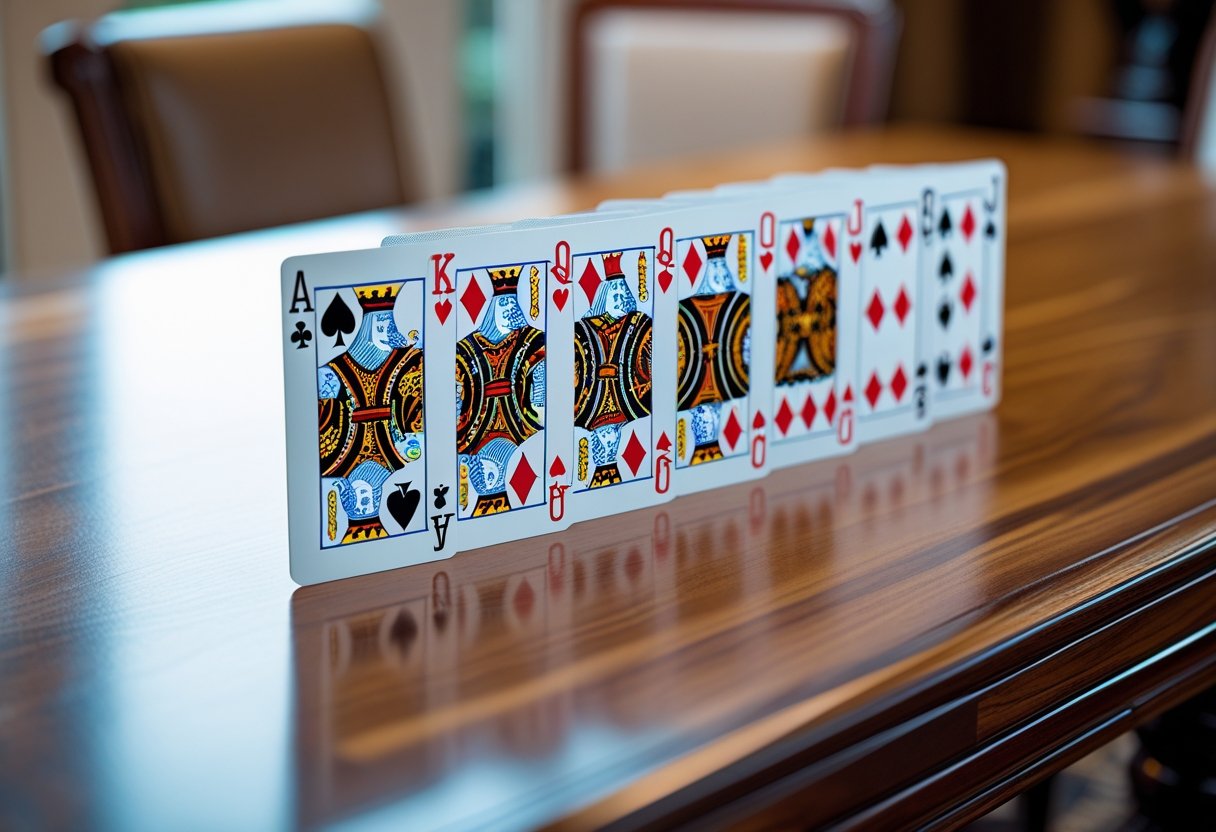
Official Standard Poker Hand Rankings
The top four poker hands ranked in order represent the strongest possible combinations a player can make from a standard 52-card poker deck. These winning hands follow a universal hierarchy that determines which five-card hand beats another in showdowns.
Royal Flush
A royal flush stands as the absolute best hand in poker. This unbeatable combination consists of five specific cards: an ace, king, queen, jack, and ten, all of the same suit.
The royal flush appears in four possible variations, one for each suit in the poker deck. A player might hold a royal flush in hearts, diamonds, clubs, or spades. No other hand can defeat it.
The rarity of this hand makes it extremely valuable. Players can spend years at poker tables without ever seeing one. When two players both have a royal flush in the same game, they split the pot equally since all royal flushes hold identical value regardless of suit.
Straight Flush
A straight flush combines two poker hand patterns into one powerful combination. This hand contains five cards in sequential order that all share the same suit.
Examples include 9-8-7-6-5 of hearts or queen-jack-10-9-8 of clubs. The highest card in the sequence determines the strength when comparing straight flushes. An ace can play as either the highest card (ace-king-queen-jack-10, which becomes a royal flush) or the lowest card (5-4-3-2-ace, called a wheel or bicycle).
A king-high straight flush beats a queen-high straight flush. This hand ranks just below the royal flush on the poker hand chart. Players rarely encounter straight flushes, but they win nearly every showdown when they appear.
Four of a Kind
Four of a kind means holding four cards of identical rank plus one unrelated card. A player might have four aces, four kings, or four of any other rank from the poker deck.
The rank of the four matching cards determines which four of a kind wins. Four aces beats four kings, which beats four queens, and so on down to four twos as the lowest possible four of a kind.
The fifth card, called a kicker, only matters when two players hold four of a kind with the same rank. This situation occurs primarily in games with community cards. A player with four jacks and an ace kicker beats four jacks with a king kicker.
Full House
A full house contains three cards of one rank and two cards of another rank. Players call this hand “threes full of twos” or similar descriptions based on the specific ranks involved.
The three matching cards (the trips or set) determine the winner when comparing full houses. Three aces with two kings beats three kings with two aces. The pair only matters if two players hold trips of the same rank.
| Full House Example | Description | Called |
|---|---|---|
| K-K-K-7-7 | Three kings, two sevens | Kings full of sevens |
| 9-9-9-4-4 | Three nines, two fours | Nines full of fours |
| A-A-A-2-2 | Three aces, two twos | Aces full of twos |
This hand ranks as the fourth-best in standard poker hand rankings. It beats all straights, flushes, and lower-ranked poker hands.
Additional Poker Hand Categories
These middle-tier hands appear frequently in poker games and require careful judgment to play well. Players need to understand when these hands are strong enough to bet and when they should proceed cautiously.
Flush
A flush contains five cards of the same suit in any order. The cards don’t need to connect in sequence. When two players both have a flush, the player with the highest card wins.
An ace-high flush beats all other flushes. If the highest cards match, the second-highest card determines the winner. This comparison continues down through all five cards if needed.
Flushes appear roughly once every 508 hands in five-card poker. They rank above straights but below full houses in standard poker hand rankings charts. Players often lose significant chips when holding a weak flush against a stronger one.
Common flush examples:
- A♠ J♠ 9♠ 6♠ 4♠ (ace-high flush)
- K♦ 10♦ 8♦ 5♦ 2♦ (king-high flush)
- 9♣ 7♣ 6♣ 4♣ 3♣ (nine-high flush)
The suit itself has no value in determining winners. A heart flush has the same strength as a spade flush if the card ranks match.
Straight
A straight consists of five consecutive cards of mixed suits. The ace can play high in a broadway straight (A-K-Q-J-10) or low in a wheel (5-4-3-2-A). The ace cannot wrap around, so K-A-2-3-4 is not valid.
Straights rank by their highest card. A queen-high straight beats a jack-high straight. All suits are equal when comparing straights.
This hand occurs approximately once every 255 hands. It ranks sixth in poker hand rankings guides, sitting between flushes and three of a kind. Straights can be difficult for opponents to detect, especially when they don’t include obvious high cards.
Straight ranking examples:
| Straight Type | Cards | Rank |
|---|---|---|
| Broadway | A-K-Q-J-10 | Highest |
| King-high | K-Q-J-10-9 | Second |
| Wheel | 5-4-3-2-A | Lowest |
Players with middle straights face tough decisions when heavy betting occurs. A straight can lose to flushes, full boats, and higher straights.
Three of a Kind
Three of a kind contains three cards of the same rank plus two unrelated cards. Players often call this hand “trips” when two matching cards appear on the board, or a “set” when they hold a pocket pair that connects with one board card.
The three matching cards determine the hand’s strength first. Three aces beats three kings. If players have identical three-of-a-kind, the highest kicker card decides the winner. The second kicker breaks any remaining ties.
This hand appears once every 47 hands in five-card poker. Sets typically win more money than trips because they’re harder for opponents to spot. Three-of-a-kind ranks seventh overall, beating two pair and one pair but losing to straights and higher hands.
Players with three of a kind often bet aggressively for value. The hand is strong enough to win most pots but remains vulnerable to opponents drawing to straights, flushes, or full houses.
Two Pair
Two pair combines two separate pairs plus one unrelated card called a kicker. The hand gets described by naming the higher pair first, such as “kings and sevens” for K-K-7-7-3.
The higher pair determines strength first. Aces and twos beats kings and queens. If the top pairs match, the second pair decides the winner. The kicker only matters when both pairs are identical.
Two pair appears roughly once every 21 hands, making it fairly common. It ranks eighth in standard poker hand rankings charts. The hand beats one pair and high card but loses to three-of-a-kind and all higher combinations.
Two pair strength comparison:
- A-A-K-K-Q (strongest possible)
- A-A-2-2-K (strong top pair, weak bottom pair)
- 3-3-2-2-A (weakest possible)
Players often face difficult decisions with two pair. The hand is strong enough to bet for value but vulnerable to opponents holding better combinations. Position and opponent tendencies heavily influence correct play.
One Pair and High Card Overview
One pair and high card represent the bottom two tiers of poker hand rankings, with one pair beating high card but losing to all other made hands. Both hands rely heavily on kickers to determine the winner when multiple players hold similar rankings.
One Pair
A one pair hand contains two cards of the same rank plus three unpaired cards. This hand beats only high card hands but loses to two pair, three-of-a-kind, straights, flushes, full houses, four-of-a-kind, straight flushes, and royal flushes.
Players make one pair roughly 42% of the time when drawing five random cards from a standard deck. In Texas Hold’em, the odds increase slightly to about 44% when all five community cards appear on the board.
A pair of aces ranks as the strongest one pair hand, while a pair of twos sits at the bottom. When two players hold the same pair rank, the highest kicker determines the winner. For example, a player holding kings with a queen kicker beats kings with a nine kicker.
Common one pair examples:
- K♥K♣9♠5♠4♦
- 8♠8♥6♠3♦2♣
- A♠A♥T♦5♣2♥
High Card
High card represents the weakest possible poker hand. A player holds a high card hand when their five cards contain no pairs, no straight, and no flush. The hand’s value comes entirely from the highest-ranking card.
When multiple players show high card hands, the player with the highest single card wins. If the highest cards match, the comparison moves to the second-highest card, then the third, and so on until a winner emerges.
An ace-high hand beats all other high card combinations. King-high ranks second, followed by queen-high and descending through the ranks. High card hands rarely win at showdown in Texas Hold’em, but they sometimes take pots when all players miss their draws.
Kickers
Kickers are the unpaired cards in a hand that break ties between hands of equal rank. They become crucial in determining winners when two or more players hold identical pairs or high cards.
In one pair hands, the three remaining cards serve as potential kickers. The highest kicker compares first, followed by the second and third if needed. A pocket pair of jacks with an ace kicker beats jacks with a king kicker, demonstrating how absolute hand strength differs from relative hand strength based on opponent holdings.
Players must consider kicker strength when deciding whether to continue in a hand. Weak kickers significantly reduce a hand’s value, especially in games with multiple opponents.
Ranking Rules and Tie Breakers
When two players have hands in the same category, specific rules determine the winner. Kickers often become the deciding factor when primary hand values match.
How Hands Are Compared
The first step compares hand categories to determine what beats what in poker. A flush always defeats a straight, and four of a kind beats a full house. The hierarchy of best poker hands follows a fixed order from royal flush down to high card.
When both players hold the same category, poker hand ranks use a step-by-step comparison method. For a straight flush or straight, the highest top card wins. A full house compares the three-of-a-kind rank first, then the pair rank second.
Flush hands compare each card from highest to lowest until a difference appears. If all five cards match in rank, the pot splits. For two pair, the higher pair determines the winner, then the lower pair, and finally the fifth card if needed.
Suits never break ties in standard poker. A heart flush and a spade flush of the same ranks result in a split pot.
Importance of Kickers in Ties
A kicker is any card not part of the main hand structure that breaks ties between matching hands. These side cards become critical when players hold identical pairs, trips, or quads.
With one pair, the three remaining cards serve as kickers. A pair of aces with K-9-5 beats a pair of aces with Q-J-10 because the king kicker is higher. The comparison continues through each kicker until a winner emerges.
Three of a kind uses two kickers when the trip ranks match. Four of a kind needs only one kicker, which matters when four matching cards appear on the board. Two pair relies on a single kicker after both pairs are compared.
High card hands treat all five cards as kickers, comparing from highest to lowest. Players who ignore kickers often misjudge hand strength and make costly errors at showdown.
How Poker Hands Are Formed
Poker hands require specific card combinations drawn from a standard deck. Players receive private cards and sometimes share common cards to build their strongest five-card combination.
Standard 52-Card Deck
A standard deck contains 52 cards divided into four suits: hearts, diamonds, clubs, and spades. Each suit includes 13 ranks, from the low card 2 through 10, followed by Jack, Queen, King, and Ace.
The Ace holds unique value in poker. It can function as the highest card in sequences like 10-J-Q-K-A or as the lowest card in A-2-3-4-5 straights.
All suits carry equal value in standard poker games. A flush in hearts ranks the same as a flush in spades when comparing hand strength. The rank of the cards within each hand determines the winner, not the suit itself.
Hole Cards and Community Cards
Different poker variants distribute cards in distinct ways. In Texas Hold’em, each player receives two private cards called hole cards that only they can see.
Community cards appear face-up on the table for all players to use. Texas Hold’em deals five community cards in stages: three on the flop, one on the turn, and one on the river. Players combine their hole cards with community cards to form their best hand.
Omaha poker gives players four hole cards instead of two. However, players must use exactly two hole cards and three community cards to make their final hand. Other poker games like Seven-Card Stud don’t use community cards at all, dealing each player individual cards throughout multiple rounds.
Five-Card Poker Hands
Every poker hand consists of exactly five cards, regardless of how many cards players receive. In Texas Hold’em, players select the best five-card combination from their two hole cards plus five community cards.
Players can use both hole cards, one hole card, or no hole cards when building their hand. The goal is always to create the strongest possible five-card combination according to standard poker rankings.
In games where players receive more than five cards total, they must choose which five create the highest-ranking hand. A player dealt seven cards in Seven-Card Stud picks the best five to compete for the pot.
Poker Hand Rankings in Popular Poker Variants
Most poker variants use the same standard hand rankings, from royal flush down to high card. However, each game type applies these rankings differently based on how players form their hands and whether the pot splits between high and low hands.
Texas Hold’em and Poker Hand Hierarchy
Texas Hold’em uses the standard poker hand rankings without any modifications. Players receive two hole cards and combine them with five community cards to make their best five-card hand.
The ranking order remains fixed: royal flush, straight flush, four of a kind, full house, flush, straight, three of a kind, two pair, one pair, and high card. Players can use both hole cards, one hole card, or no hole cards when forming their final hand.
Position affects hand value in Texas Hold’em more than rankings themselves. A pair of jacks plays stronger from late position than early position because players have more information about opponents’ actions. Strong starting hands include high pairs, suited connectors, and high-suited cards.
Omaha and Omaha Hi-Lo
Omaha follows standard hand rankings but requires players to use exactly two hole cards and three community cards. Players receive four hole cards instead of two, creating more possible combinations.
Pot-Limit Omaha produces stronger hands on average than Texas Hold’em because of the extra hole cards. Full houses and flushes occur more frequently, making these hands less valuable relative to the field.
Omaha Hi-Lo splits the pot between the best high hand and the best low hand. The low hand must qualify with five unpaired cards ranked eight or lower. Straights and flushes don’t count against low hands. A player can win both halves of the pot with different five-card combinations from their cards.
Seven Card Stud
Seven Card Stud deals no community cards. Each player receives seven cards total: three face down and four face up. Players make their best five-card hand from these seven cards using standard rankings.
The game proceeds through multiple betting rounds as cards are revealed. Players must track visible cards to calculate odds and assess opponent hand strength. Hand values shift throughout the hand as more information becomes available.
Strong starting hands include three of a kind, high pairs, and three cards to a flush or straight. Players fold weaker hands early because drawing cards costs money through each betting round.
Poker Hand Rankings in Online Poker
Online poker platforms use identical hand rankings across all game types. The software automatically evaluates hands and awards pots based on the standard hierarchy.
Digital displays show hand rankings and odds in real time. Many online poker sites include built-in hand strength meters that help players understand where they stand. These tools prove valuable for beginners learning how different hands compare.
Online poker moves faster than live games, requiring players to make quicker decisions about hand strength. The dealing and pot calculation happens instantly, letting players focus entirely on strategy and hand evaluation rather than game mechanics.
Special Cases and Non-Standard Poker Hand Rankings
Some poker games flip the traditional rankings upside down or introduce unique rules that change which hands win. In lowball games like 2-7 Triple Draw and Razz, the weakest traditional hands become winners, while games like Badugi use completely different evaluation systems. Wild cards add another layer of complexity by allowing players to create hands that wouldn’t exist in standard poker.
Lowball and 2-7 Triple Draw
Lowball poker reverses the standard hand rankings so the lowest hand wins the pot. In 2-7 Triple Draw, the best possible hand is 7-5-4-3-2 with no flush, called a “wheel” or “number one.” Straights and flushes count against the player in this variant, making them undesirable.
Aces always play high in 2-7 Triple Draw, never low. This means A-2-3-4-5 is not a strong hand because it forms a straight. The second-best hand is 7-6-4-3-2, followed by 7-6-5-3-2.
Players want unpaired hands with the lowest possible cards that don’t form straights or flushes. An 8-low hand beats a 9-low hand, and if two players both have 8-lows, the second card determines the winner. A hand like 8-6-4-3-2 loses to 8-5-4-3-2 because the second card is higher.
Razz and Badugi
Razz uses traditional poker hand rankings but rewards the lowest hand, similar to lowball. The key difference is that straights and flushes don’t count against players in Razz. The best possible hand is 5-4-3-2-A, called the “bicycle” or “wheel,” where the ace plays low.
Players compare hands by looking at the highest card first. A hand with a 7 as the highest card beats any hand with an 8 or higher. Pairs and higher combinations are undesirable and counted as high.
Badugi uses a completely different ranking system based on four cards instead of five. The goal is to make the lowest four-card hand with one card from each suit and no pairs. The best possible hand is A-2-3-4 with each card in a different suit.
If players have duplicate suits or pairs, those cards don’t count. A three-card badugi beats any two-card hand, and a four-card badugi beats all three-card hands.
Wild Card Games and Alternate Hand Rankings
Wild cards can replace any card in the deck, creating hands that don’t exist in standard poker. The most common wild card is the joker, though games sometimes designate deuces or one-eyed jacks as wild. Five of a Kind becomes possible when wild cards are in play, ranking above a Royal Flush as the best possible hand.
House rules determine exactly how wild cards work and whether special hands are recognized. Some games allow hands like “big cats” (King high to 8 low with no pairs) or “skeet” (9-5 with a deuce and two cards between 5 and 9). These non-standard hands typically rank between straights and flushes.
Wild card strategy differs significantly from standard poker because players can complete powerful hands more easily. The presence of wild cards also changes the relative value of natural hands, making traditionally strong holdings like three of a kind much weaker when opponents can make five of a kind or wild royal flushes.
Poker Hand Charts and Cheat Sheets
Charts and cheat sheets provide quick visual references for hand rankings, starting hands, and odds. Players can keep these guides nearby during games to make faster decisions without memorizing every detail.
Printable Poker Hand Charts
Printable poker hand charts show all ten hand rankings from Royal Flush down to High Card in a single-page format. These charts typically include example hands for each ranking, making it easy to identify what beats what during gameplay.
Most poker hand charts use clear graphics with card symbols to display each hand type. The best charts include tie-breaker rules and kicker information to help players determine winners when multiple players have the same hand rank.
Players can download these charts as PDFs or images and print them for home games. Many poker sites offer free downloadable versions that fit on standard letter-size paper. Some charts also include probability percentages for each hand type, showing how rare or common each combination is.
New players should keep a printed chart at the table until they fully memorize the rankings. Online poker players can save digital versions on their phones or second monitors for quick reference during play.
Using Poker Hand Rankings Guides
Poker hand rankings guides expand beyond basic charts to include starting hand recommendations and position-based strategies. These guides show which hole cards to play from early, middle, and late positions at the table.
A complete poker cheat sheet includes pre-flop hand charts that rank starting hands from premium pairs like pocket aces down to marginal hands. Players learn which hands to fold, call, or raise based on their table position and the current action.
Advanced guides incorporate poker hand odds and equity calculations. These tools help players understand their chances of improving on later streets and making profitable decisions. Some cheat sheets include pot odds charts and betting guidelines for different situations.
Players should use these guides as learning tools rather than permanent crutches. Regular review helps transfer the information from the cheat sheet into working memory for faster in-game decisions.
Probabilities, Odds, and Poker Hand Frequency
Understanding poker hand odds helps players make better decisions at the table. A royal flush occurs once every 649,740 hands in five-card poker, while common hands like one pair appear in about 42% of all deals.
Odds for Standard Poker Hands
Poker hand odds express how likely a player is to receive specific hands from a standard 52-card deck. The odds against drawing a royal flush stand at 649,739 to 1, making it the rarest possible hand. Straight flushes follow at 72,192 to 1.
Four-of-a-kind (quads) appears once every 4,165 hands, with odds of 4,164 to 1 against. A full house occurs more frequently at 693 to 1 odds. Players receive pocket aces or pocket kings at a rate of 1 in 221 hands for each specific pair.
Common Hand Odds (5-Card Poker)
| Hand | Odds Against | Probability |
|---|---|---|
| Royal Flush | 649,739 : 1 | 0.000154% |
| Straight Flush | 72,192 : 1 | 0.00139% |
| Four of a Kind | 4,164 : 1 | 0.024% |
| Full House | 693 : 1 | 0.144% |
| Flush | 508 : 1 | 0.197% |
| Straight | 254 : 1 | 0.392% |
One pair hands dominate at 1.37 to 1 odds, appearing in 42.3% of deals.
Frequency of Rare Hands Like Quads and Full House
Out of 2,598,960 possible five-card combinations, only 624 result in four-of-a-kind. This frequency translates to roughly one quad hand per 4,165 deals. Full houses occur 3,744 times among all possible hands, appearing about six times more often than quads.
In seven-card games like Texas Hold’em, these frequencies shift dramatically. Players make quads 224,848 times out of 133,784,560 possible seven-card combinations. Full houses jump to 3,473,184 occurrences, making them considerably more common in community card games.
The gap between rare hands matters for strategy. A full house beats a flush but loses to quads, yet players encounter flushes (5,108 combinations) more often than full houses in five-card poker. In seven-card formats, full houses actually appear less frequently than flushes despite their higher rank.
Frequently Asked Questions
Players often have questions about hand rankings, probabilities, and how to use this knowledge effectively at the table. Understanding these common concerns helps build a stronger foundation for poker success.
What are the different hand rankings in Texas Hold’em poker?
Texas Hold’em uses the standard ten-hand ranking system that applies to most poker variants. The rankings from highest to lowest are Royal Flush, Straight Flush, Four of a Kind, Full House, Flush, Straight, Three of a Kind, Two Pair, One Pair, and High Card.
Each hand type beats all hands ranked below it. A Royal Flush consists of A-K-Q-J-10 all in the same suit and represents the unbeatable top hand.
The rankings remain consistent whether playing cash games or tournaments. Players use their two hole cards combined with five community cards to make the best possible five-card hand.
How do you determine the winner of a poker round based on hand rankings?
The winner is determined by comparing the hand rankings of all players who remain at showdown. The player with the highest-ranked hand type wins the pot.
When multiple players have the same hand type, specific tie-breaking rules apply. The ranks of the cards within that hand type determine the winner.
For example, if two players both have a flush, the player with the highest card in their flush wins. If the highest cards match, the comparison moves to the second-highest card, then the third, and so on until a winner emerges.
If all five cards are identical in rank, the pot is split equally among the tied players. Suits have no bearing on hand strength in standard poker games.
What is the probability of being dealt each type of poker hand?
A Royal Flush appears approximately once every 649,740 hands in five-card poker, making it the rarest hand. In Texas Hold’em, where players use seven cards, the odds improve to roughly once every 30,940 hands.
Straight Flushes occur about once every 72,193 hands. Four of a Kind appears approximately once every 4,165 hands.
Full Houses occur once every 694 hands, while Flushes appear once every 508 hands. Straights happen about once every 255 hands.
Three of a Kind occurs approximately once every 47 hands. Two Pair appears once every 21 hands, making it fairly common.
One Pair is the most frequent made hand, occurring roughly once every 2.37 hands. High Card hands appear about 50% of the time but rarely win at showdown.
Can you provide a chart listing poker hands from highest to lowest?
The complete ranking chart shows all ten hand types in order of strength:
- Royal Flush – A, K, Q, J, 10 all in the same suit
- Straight Flush – Five consecutive cards in the same suit
- Four of a Kind – Four cards of the same rank
- Full House – Three of a kind plus a pair
- Flush – Five cards of the same suit
- Straight – Five consecutive cards in mixed suits
- Three of a Kind – Three cards of the same rank
- Two Pair – Two separate pairs
- One Pair – Two cards of the same rank
- High Card – No pairs or combinations
This ranking system applies to virtually all poker variants. Players should memorize these rankings before playing for real money.
What are the best starting hands in poker, and why are they superior?
Pocket Aces (two aces as hole cards) represents the strongest starting hand in Texas Hold’em. This hand gives players the highest pair possible before any community cards appear.
Pocket Kings ranks as the second-best starting hand, followed by Pocket Queens and Pocket Jacks. These high pairs have strong equity against most other starting hands.
Ace-King suited is considered one of the best non-pair starting hands. It offers multiple ways to win, including making top pair with the best kicker, flushes, and straights.
These hands are superior because they have the highest probability of winning at showdown. They also offer flexibility in how they can improve with community cards.
Premium pairs maintain their strength even when facing multiple opponents. High cards reduce the chances of being dominated by an opponent holding higher cards.
How can a poker hand calculator help improve my understanding of hand rankings?
A poker hand calculator shows the exact winning probability of specific hands against opponents’ ranges. Players enter their hole cards and can input known community cards to see their equity.
These tools help players understand how different hands perform in various situations. Seeing concrete percentages makes abstract concepts about hand strength more tangible.
Calculators demonstrate how hand strength changes as community cards appear. A strong starting hand can become vulnerable, while a weak hand might improve to become dominant.
Regular use of these calculators builds intuition about relative hand strength. Players learn which hands are worth playing aggressively and which require caution.
Many calculators allow users to run simulations across thousands of possible scenarios. This accelerates learning by showing outcomes that might take years to experience at actual tables.