

Searchable.com organizes its platform around three steps, Monitor, Analyze and Create, and the clearest way to understand that order is to look at what goes wrong without it. Teams new to AI search can fall into a handful of errors:
- Judging visibility from a few questions typed into a chatbot
- Watching one number and calling it the score
- Tracking only prompts that already name the brand
- Letting AI referrals vanish into “direct” traffic
- Writing content before knowing where the gaps are
- Publishing pages at volume to fill a quota
- Expecting a change to show up within days
Each section below takes one of those mistakes, explains why it misleads, and shows which part of the Monitor, Analyze, Create sequence is designed to catch it.
Stop Judging Visibility From a Few Manual Checks

Typing your category into ChatGPT on a Monday morning feels like research. It is one reading, from one account, at one moment.
Searchable’s article on AI visibility tracking says AI answers have no fixed positions, and it cites SparkToro research in which fewer than 1 in 1,000 of 2,961 runs returned the same list. A spot check cannot tell you whether what you saw was typical.
Example. Illustrative only. A marketer checks five prompts by hand each week. The same article suggests tracking 60 to 100 or more prompts and reviewing them weekly, so the manual habit covers a small slice of that range.
The Monitor step replaces the habit with repetition. According to the pricing page, prompts run daily across available AI models, and the home page lists real-time alerts for mentions, ranking changes and competitor activity.
Tip. Let alerts tell you when something moves. Use your own time for reading the evidence behind the change.
Read Several Measures Side by Side
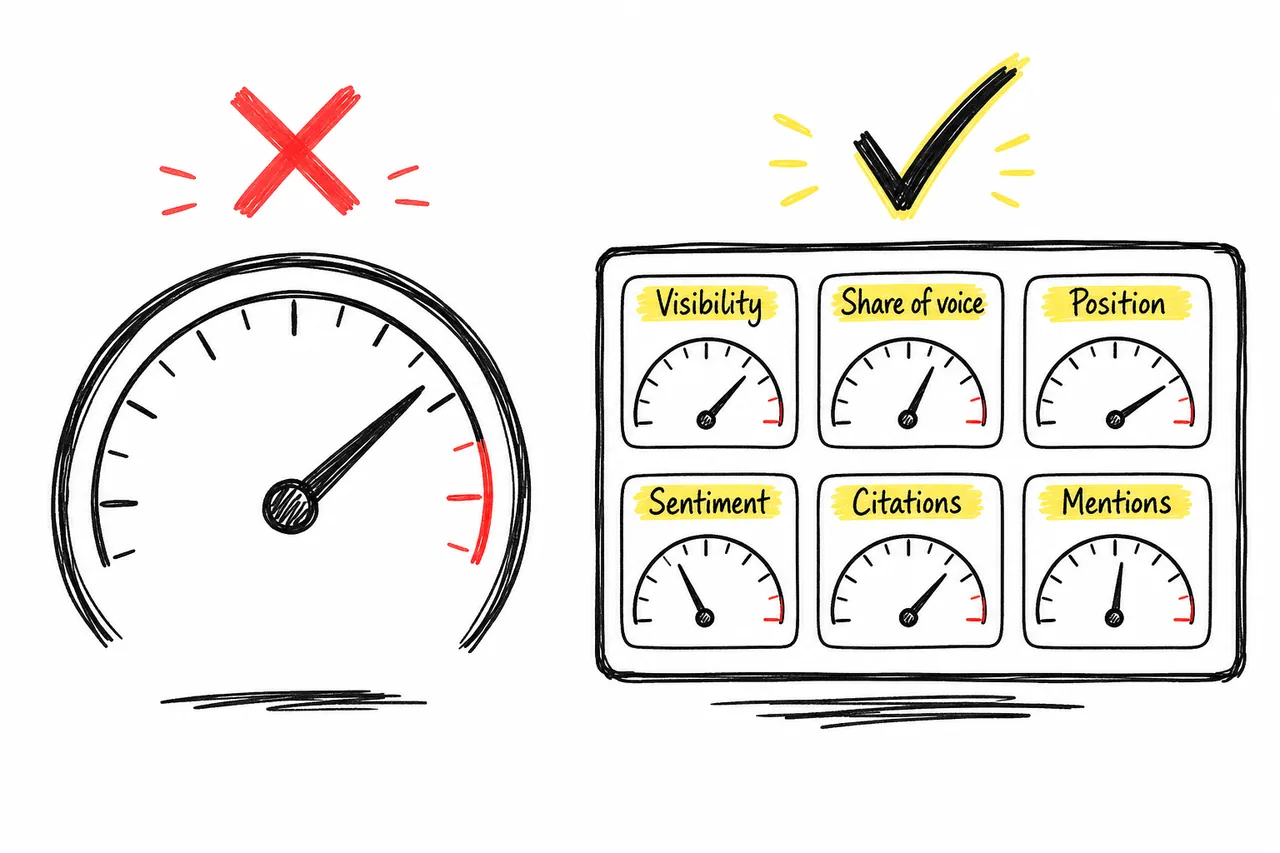
The AEO Insights page puts it in one line: “AI visibility does not live in one metric.” Any single figure hides something the others would show.
| If you only watch | What you can miss |
|---|---|
| Visibility score | Whether engines describe you positively, neutrally or negatively |
| Sentiment | Whether you appear often enough for tone to matter |
| Citation count | Ghost citations, which Searchable defines as links to your site that never mention your brand name |
| Share of voice | Which domains and URLs the engines actually cite |
| One engine | Platform coverage across the others you care about |
Where position fits
AEO Insights also reports average position. That sits beside a firm line in Searchable’s own tracking article: “Any tool that claims to show your ‘AI rank’ is selling noise as signal.”
Caveat. One reasonable way to hold both ideas is to treat average position as a trend across many runs, never as a fixed place on a page.
Track the Questions That Never Mention Your Name
Branded prompts are comfortable. People who type your name usually get an answer about you. The harder test is whether you appear when someone asks about the problem you solve.
Searchable’s article on improving AI brand visibility reports that the median brand appears in 93% of branded prompt answers and 7% of unbranded ones. The Prompts feature is built to cover that second group, with prompt types such as:
- Category searches with no brand in them
- Buyer questions about a specific need
- Competitor comparisons
- Use-case and local variations
Prompts can be grouped as branded or unbranded, so the two never blur together in one average. Topic, funnel stage, intent and location are available as groupings as well. The feature also separates tracking known prompts from researching new questions you had not thought to ask.
Separate AI Referrals From Direct Traffic
Visits from assistants often land in analytics without a clear label. If they sit inside “direct”, nobody can say whether AI search sends anyone at all. The Traffic feature exists to pull them apart.
- Connect Google Analytics 4 and Search Console to Traffic through OAuth.
- Read referrals from ChatGPT, Perplexity, Claude and others as their own group, apart from organic search and “direct”.
- Compare those visits with conversions, not only clicks, which is also what Google’s Search Central blog advises.
- Remember that Google counts its AI feature traffic within the Web search type in the Search Console Performance report.
Point four matters. Google AI Overviews and AI Mode visits will not show up as a separate line in Search Console, so the split has to come from elsewhere.
Point three matters too. Google’s Search Central blog describes clicks from AI Overview result pages as “higher quality”, which is a reason to judge these visits by what they lead to rather than by raw volume.
Find the Gap Before Writing Anything
A common reflex is to answer weak visibility with new blog posts. The Analyze step asks a prior question: what do the answers show is missing?
| Evidence in AEO Insights | What it can tell you |
|---|---|
| Response-level evidence | Exactly how an engine phrased its answer |
| Cited domains and URLs | Which sources the engine leaned on |
| Content gaps | Prompts where competitors are cited and you are not |
| Query variations | How small wording changes shift the answer |
Sometimes the gap is factual rather than editorial. In Searchable’s brand sentiment study, the most common negative descriptor was “limited”, used for 898 brands, and the article says this often reflects an information gap.
The evidence may also point off your site. When a competitor is cited through a review site or news article, Searchable’s article on improving AI brand visibility puts earning coverage on sources AI already reads at the top of its order of impact. A new page on your own domain would not close that gap.
Do Not Fill an Article Allowance for Its Own Sake
Create comes last in the sequence for a reason. Content Studio handles planning and drafting, but a monthly article count is capacity, not an instruction.
Warning. Google’s guidance on generative AI content says producing many pages without adding value may violate its spam policy on scaled content abuse.
Searchable’s article on ranking in AI Overviews makes a similar point from the other direction, calling for unique, non-commodity content. Google’s own Search Central blog uses almost the same words. When you do write, Searchable’s AEO article recommends opening with a direct answer of 40 to 60 words, though page structure is a subject of its own.
So draft against a specific gap found in the Analyze step. Then put the draft through human review, because the terms say the company’s indemnity does not extend to the content of generative AI outputs.
Give Each Change Weeks Before Judging It
Publish a fix on Tuesday, check ChatGPT on Wednesday, and you will probably learn very little.
Searchable’s sentiment article says changes in how engines describe a brand take weeks. The home page goes further with a brand claim that “ranking improvements typically begin within 2-4 weeks”. That claim is the company’s own, and it pulls against the same company’s view that AI rank is noise.
Note. Read any timeline as a reason to keep monitoring weekly, not as a promise. The loop returns to Monitor after every change.
Waiting is not the same as doing nothing. Watch citation trends and mention trends for the prompts the change was meant to affect, and keep already-cited pages current, which Searchable’s article on improving AI brand visibility lists among its priorities.
Check What Searchable.com Does Not Promise
A method can reduce mistakes without removing every risk. The company’s own pages set out several limits.
- The terms do not warrant that the service will be uninterrupted, error-free or secure.
- LLM Analytics, which covers AI crawler activity and crawl-to-click attribution, is marked beta.
- The pricing page treats ChatGPT, Google AI Overviews and Perplexity as core engines, with Copilot, Claude and Grok as add-ons and DeepSeek as a custom integration.
- The service is for business use only and is not offered to consumers.
Each of these points changes how much weight a single dashboard figure can carry, especially for data marked beta or engines outside the core group.
Caveat. This is a short summary, not legal advice; the current terms on the company’s site are what apply.
Run This Checklist Before Each Weekly Review
Use it to confirm the process, not the results.
- Prompts run on a schedule, and nobody is relying on hand-typed checks.
- At least two measures are read together, including sentiment.
- Unbranded prompts are grouped apart from branded ones.
- AI referrals are separated from organic and “direct” traffic.
- Every new draft points to a named gap from the evidence.
- No page goes live without human review.
- Any add-on engine the team depends on is confirmed on the pricing page.
- Recent changes have had several weeks before anyone judges them.